
Learning to read the Quran can feel overwhelming when the letters, pronunciation, and reading rules are unfamiliar. You may be starting as an adult, returning after a long break, or helping your child begin.
You do not need to learn everything at once. A manageable approach is to recognize Arabic letters, understand vowel marks, practice joining sounds, and gradually read Quranic passages with guidance.
This guide explains where to start, how to organize your practice, and what to look for in a Quran teacher.
Where Should a Beginner Start?
To begin reading the Quran, learn Arabic letter shapes and sounds, then practice short vowels, connected letters, and simple words. Introduce correct pronunciation and basic Tajweed as you progress, with regular feedback from a teacher.
Your starting point depends on what you already know:
| Your current ability | A useful next step |
|---|---|
| You cannot recognize Arabic letters | Begin with the alphabet and individual sounds |
| You recognize letters but struggle with words | Practice connected forms and vowel marks |
| You can read slowly but make frequent mistakes | Work on accuracy and pronunciation |
| You can read comfortably but need recitation guidance | Focus on Tajweed and correction |
An initial assessment can help you avoid repeating material you already understand or moving ahead before your foundations are ready.
1. Learn Arabic Letter Shapes and Sounds
Begin by learning to recognize each letter and pronounce it clearly.
Some Arabic letters have similar shapes but different dots. Others may sound similar to an English-speaking beginner, even though they are distinct in Arabic. Pay attention to both the written form and the sound.
For example, practice distinguishing:
- ب، ت، ث — letters with a similar basic shape but different dots.
- ح، خ، ه — letters whose pronunciation needs careful listening.
- س، ص — different sounds that should not be treated as interchangeable.
Rather than memorizing letter names alone, practice the sounds you will use when reading.
Ask your teacher to demonstrate a sound, repeat it yourself, and receive correction. A recording can help you listen again, but it cannot tell you whether your own pronunciation is accurate.
Practice letters in different positions
Many Arabic letters change shape depending on their position in a word. Learn to recognize them at the beginning, middle, and end, as well as on their own.
Do not assume you have mastered a letter simply because you recognize it on an alphabet chart. Try identifying it in an unfamiliar word too.
2. Understand Vowel Marks and Reading Signs
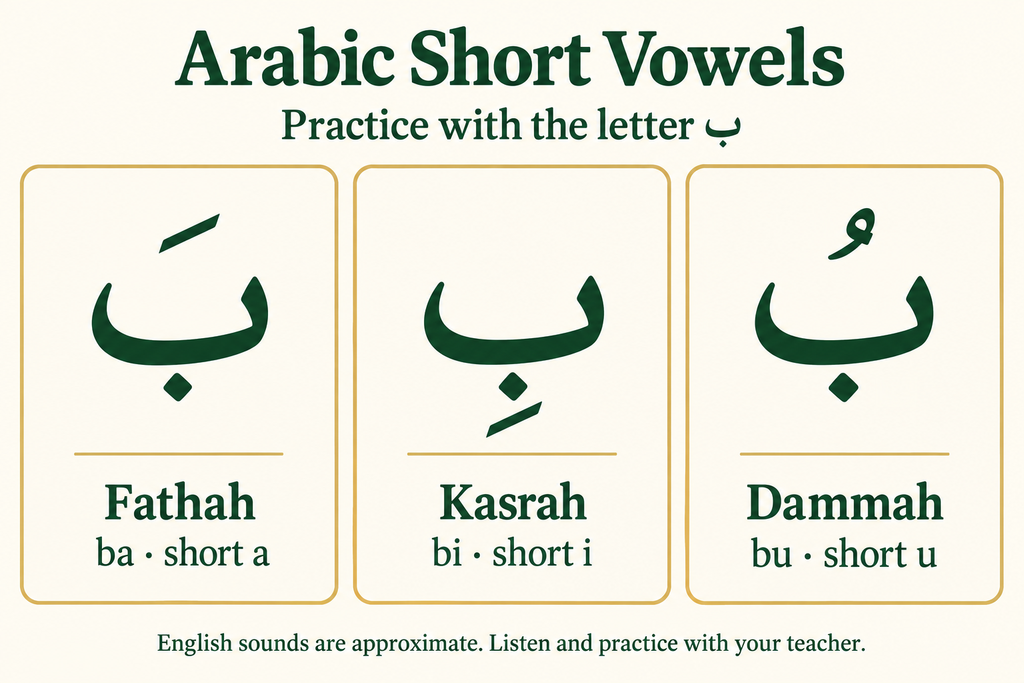
Once you recognize letters, begin learning the marks that guide their pronunciation. The first short vowels usually introduced are:
| Mark | Name | Basic reading function |
|---|---|---|
| َ | Fathah | Adds a short “a” vowel |
| ِ | Kasrah | Adds a short “i” vowel |
| ُ | Dammah | Adds a short “u” vowel |
These English descriptions are approximate. Learn the actual sounds through listening and guided practice.
You will also encounter:
- Sukun: Indicates that a consonant has no following vowel.
- Shaddah: Indicates a doubled consonant.
- Tanween: Vowel endings that include an “n” sound when read in connected recitation, subject to the relevant rules.
- Long vowels: Sounds that are extended beyond short vowels.
Practice each new sign in simple combinations before trying to read a full passage. Your teacher can also explain how pronunciation changes when stopping at the end of a word or verse.
3. Use a Beginner Reading Book to Build Foundations
A structured primer, such as Noorani Qaida, can organize early practice into manageable lessons.
Depending on the book and teaching method, lessons may cover letter recognition, connected forms, vowel marks, and introductory reading rules. The book provides a sequence; the teacher helps you use it correctly.
Before moving on from a lesson, check whether you can:
- Recognize the letters without guessing.
- Read the vowel marks accurately.
- Distinguish sounds you previously confused.
- Read examples in a different order.
This last point matters. If you can recite a line only because you remember its rhythm, you may need more practice reading the individual letters and signs.
Not every beginner needs to complete the same book from the first page. A learner who already reads Arabic may benefit more from targeted correction.
4. Practice Joining Sounds into Words
The next step is moving from individual sounds to connected reading.
Start with short combinations. Read slowly enough to notice each letter and vowel, then join the sounds without adding extra vowels or dropping letters.
A useful practice method is:
- Look carefully at the word.
- Identify any unfamiliar letter or sign.
- Read it slowly.
- Listen to your teacher’s correction.
- Read it again independently.
Aim for accuracy before speed. Reading a small amount carefully gives you something reliable to build on.
If the same mistake keeps returning, pause and practice that specific sound or combination instead of repeatedly reading the whole page.
5. Introduce Tajweed as You Learn
Tajweed concerns the rules of correct Quranic recitation, including letter pronunciation and how sounds are treated in different combinations.
You do not have to memorize every technical term before beginning. However, correct pronunciation should be part of your learning from the start.
The Quran instructs measured recitation in Surah Al-Muzzammil, verse 4. This provides an important reference for approaching recitation with care. Read Quran 73:4.
Early lessons can introduce:
- Where letter sounds are produced.
- The difference between short and long vowels.
- How doubled consonants are pronounced.
- Basic stopping guidance.
- Additional rules as they appear in your reading.
Ask your teacher to demonstrate a rule using the passage you are studying. Connecting an explanation to an actual example makes the lesson easier to practice.
6. Begin Reading Short Quranic Passages
When your foundations are ready, your teacher can introduce short passages at an appropriate level.
Familiarity can help, but take care with passages you have already memorized. Reciting from memory and reading from the page are different skills.
To strengthen reading:
- Follow the written words as you recite.
- Notice the vowel marks instead of relying only on memory.
- Read a small section independently before listening again.
- Ask for correction when you are unsure.
You can also read a reliable translation to begin exploring the meaning. Learning to pronounce Arabic text and learning to understand Arabic are related but separate goals; both deserve attention.
7. Follow a Realistic Daily Practice Routine
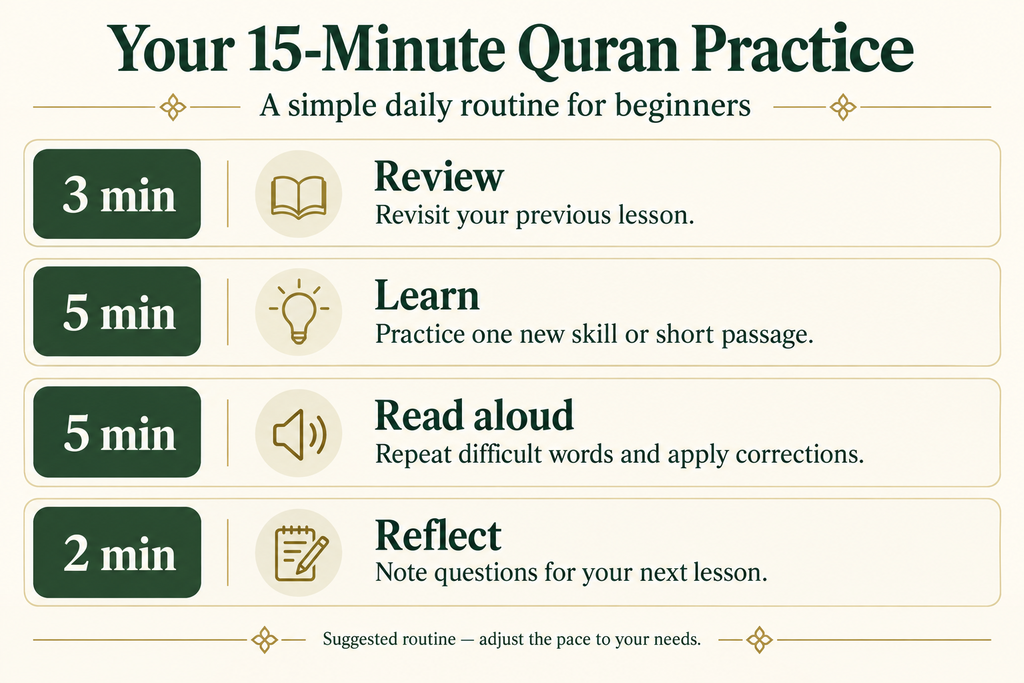
Choose a routine you can maintain alongside work, school, and family responsibilities.
The following 15-minute session is a suggested starting point, not a required schedule:
| Time | Activity |
|---|---|
| 3 minutes | Review the previous lesson |
| 5 minutes | Practice one new skill or short passage |
| 5 minutes | Read aloud and revisit corrected mistakes |
| 2 minutes | Note what needs help in your next lesson |
Younger children may need shorter sessions with breaks. Other learners may prefer longer practice periods.
Keep your goal specific. “Practice the letters I confuse” is more useful than “read more.” A simple notebook can help you record corrections and notice progress over time.
Common Mistakes to Avoid
Trying to read quickly before reading accurately
Speed should not be your first measure of success. Notice whether you are recognizing letters more confidently and making fewer repeated mistakes.
Depending entirely on transliteration
English-letter transliteration may provide temporary support, but it cannot represent every Arabic sound precisely. Gradually build confidence reading the Arabic script itself.
Only listening without reading aloud
Listening provides a model. Reading aloud lets you practice producing the sounds and gives your teacher something to assess.
Moving on without reviewing corrections
A correction during class needs follow-up practice. Return to difficult examples in your next session rather than assuming one successful attempt means the skill is secure.
Comparing your progress with someone else’s
Previous Arabic exposure, practice time, age, and learning needs all affect the experience. Compare your current reading with your own earlier attempts.
Can Adults Learn to Read the Quran from the Beginning?
Yes. You can begin as an adult, including if you have no previous experience reading Arabic.
Tell your teacher honestly what you find difficult. You may need help with unfamiliar sounds, remembering letter shapes, or building confidence reading aloud.
Choose a learning environment where you can ask questions without feeling rushed. A clear sequence and regular correction can make the process more manageable.
If you are returning after a long break, start with an assessment. You may remember more than you expect while still needing to revisit particular foundations.
How Can Parents Help Children Practice?
Support your child’s learning with calm, manageable practice.
Ask the teacher what to review between lessons, then focus on that material. Praise specific effort, such as recognizing a difficult letter or correcting a mistake independently.
Avoid turning every session into a test or comparing siblings.
If you are unsure about pronunciation yourself, make a note for the teacher rather than guessing. Your role can be to encourage the routine and help your child arrive at lessons prepared.
How to Choose an Online Quran Teacher
Look beyond the length of the lesson or the number of pages promised. Before enrolling, ask:
- Will the teacher assess my current reading level?
- How will pronunciation mistakes be corrected?
- What should I practice between lessons?
- How will we decide when I am ready to move forward?
- Can lessons adapt to my age, goals, and schedule?
During an introductory lesson, notice whether the teacher listens carefully, explains clearly, and gives you time to try again.
For learners who want individual guidance, our personalized online Quran classes offer a place to explore the learning options. You can also review the class pricing and lesson plans when planning your schedule.
Frequently Asked Questions
Do I need to speak Arabic before learning to read the Quran?
No. You can begin learning the Arabic script and pronunciation without already speaking Arabic. Understanding vocabulary and meaning is a separate part of learning that you can develop alongside reading.
How long does it take to learn to read the Quran?
There is no single timeline for every beginner. Your starting level, practice routine, and the skills you are working toward all matter. Ask your teacher for practical milestones based on an assessment rather than a guaranteed completion date.
Is Noorani Qaida necessary for every learner?
Not necessarily. It is one option for organizing foundational reading practice. Your teacher may use another primer or focus on particular lessons if you already know the basics.
Can I learn using videos and recordings?
Videos and recordings can support practice and revision. A teacher adds direct feedback on your reading, including mistakes you may not notice yourself.
Should I learn reading or memorization first?
Discuss both goals with your teacher. You may practice short memorized passages while developing reading skills, but memorization should not replace learning to recognize and read the text accurately.
Take Your First Step
Begin with the skill you need today: recognizing a letter, reading a vowel correctly, or improving one recurring pronunciation mistake.
At Online Quran Learning School, our approach centers on personalized lessons that match the learner’s current level and goals.
Contact us about getting started and tell us whether you are learning for yourself or looking for lessons for your child.